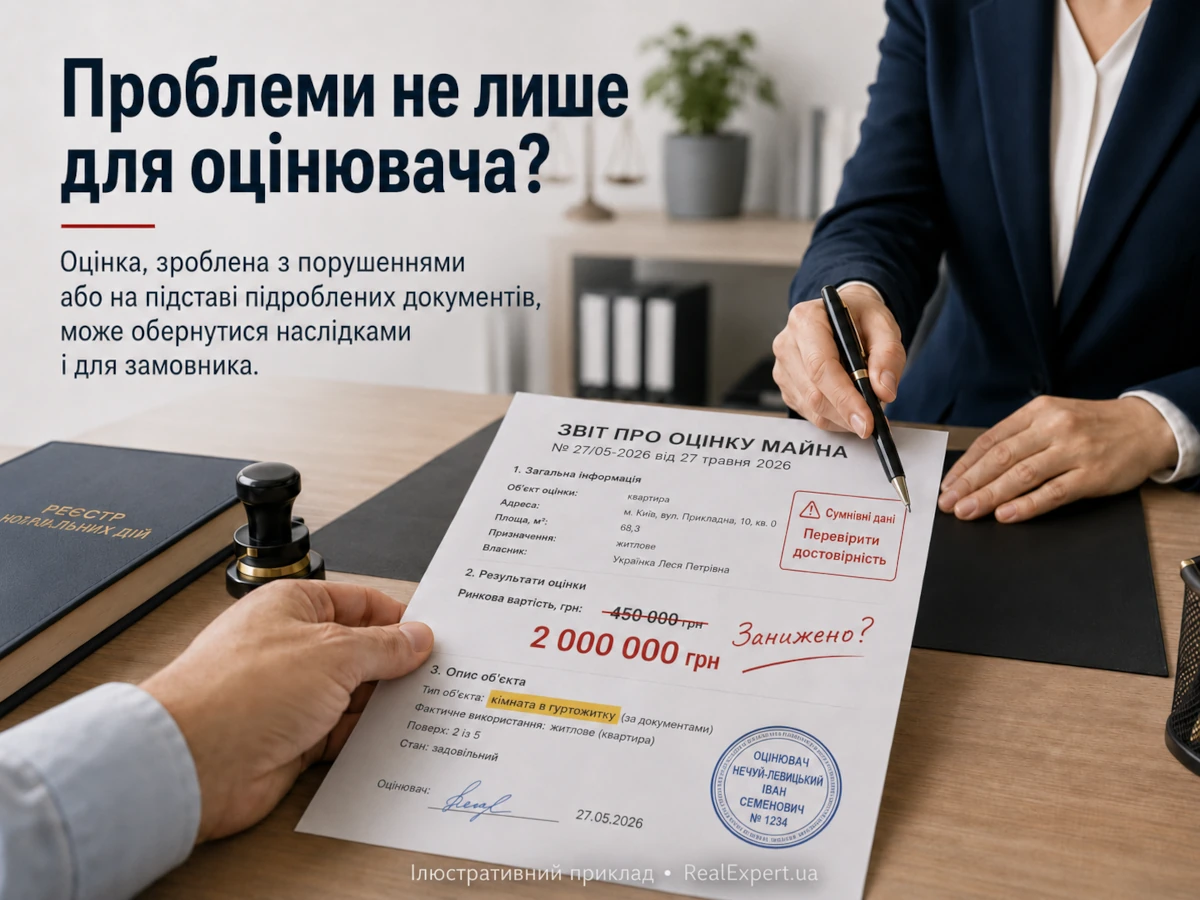
In an ordinary real estate or property transaction, documents are often treated as a formality. There is a technical passport, an extract, a title document, a sale and purchase agreement, a power of attorney — so it seems that valuation can be ordered quickly and the matter can move on to a notary, court or accounting department.
In practice, it is a little more complicated. One incorrect cadastral number, an outdated apartment area, an error in a title document or a mismatch between the technical passport and the register can stop the process. If inaccurate data gets into the valuation report, the consequences may be even more serious.
It is especially risky when valuation is requested not according to the market, but “as needed”: lower for taxes, higher for court, adjusted to the contract price or to an internal decision of a company. In such a case, the problem is not only the figure itself. A valuation report is an official document, and its content must correspond to facts, valuation methodology and market evidence.
Why documents matter in property valuation
Property valuation does not start with a formula or a search for comparable offers. It starts with understanding the object. The appraiser has to establish what exactly is being valued: an apartment, a house, a land plot, a share in ownership, a vehicle, equipment, corporate rights or another asset.
Under the Law of Ukraine “On Valuation of Property, Property Rights and Professional Valuation Activity in Ukraine”, the client must provide the appraiser with access to the property and the necessary reliable information about it. This is important: an appraiser does not invent the characteristics of an object, but works with documents, inspection results, open sources and market data.
If documents state one area, while the object actually has different characteristics, the valuation may be incorrect. If a title document contains an old address description while the register already shows a different address, a notary or a court may request clarification. If the client hides encumbrances, unauthorized reconstruction or ownership issues, this also affects whether the report can be properly used.
What documents an appraiser usually needs
The list of documents depends on the type of property and the purpose of valuation. For valuation of an apartment or house, title documents, a technical passport or other documents with technical characteristics, owner details and the purpose of valuation are usually needed. For land valuation, the cadastral number, area, designated use and documents confirming the right to the land are important.
For vehicle valuation, the appraiser reviews registration documents, make, model, year of manufacture, VIN, technical condition and configuration. For equipment valuation, furniture, fixed assets or inventory, the appraiser may need inventory lists, commissioning acts, primary accounting documents, photos, technical specifications and accounting data.
For valuation of corporate rights, shares or securities, the documents are different: charter documents, financial statements, information about the participant’s share, balance sheet, data on the company’s assets and liabilities. There is no single universal list. But the common rule is simple: documents must allow the appraiser to identify the property and understand which rights are being valued.
What the appraiser checks and what is outside the appraiser’s task

The appraiser checks documents within the scope of professional valuation work. He or she compares the name of the object, address, area, year of construction, cadastral number, owner, valuation date, purpose of valuation and other data that may influence the result. If something does not match, a conscientious appraiser should ask clarifying questions, request an additional document or explain that a report should not be prepared on the basis of such input data.
However, an appraiser does not replace a notary, a state registrar, a lawyer or a forensic document expert. The appraiser does not conduct handwriting analysis, does not examine the authenticity of a signature under a microscope and does not analyze the composition of paper. If a document looks suspicious, contains signs of corrections, does not match register data or raises legal questions, this is a reason not to “turn a blind eye”, but to sort out the documents first.
Sometimes the problem is an ordinary technical error: a wrong letter in a surname, an old address, a different area after inventory, or the absence of an updated technical passport. Such things can often be corrected or explained. But there are also situations where a document is not merely inaccurate, but looks as if it was artificially prepared for a specific action.
An error in a document is not always forgery
It is important not to confuse an error with forgery. An error may appear because of old documents, a technical typo, a change of address, a street renaming, inaccurate inventory data or different approaches to measuring area. In older housing stock this happens quite often: one area in the title document, another in the technical passport, and yet another in a register extract.
Forgery is a different situation. It means that a document has been fully or partially created or changed so that it confirms false facts or gives a person a right that he or she does not actually have. This may be a fake power of attorney, a forged agreement, an altered area, a forged signature, an unreliable technical document, a fictitious certificate or another document used for a transaction, court case, inheritance or accounting purposes.
From the valuation point of view, the difference is fundamental. If there is an error, it should be corrected or properly taken into account in the report. If there is a suspicion of forgery, the appraiser should not pretend that everything is fine. Otherwise, questionable input data may become part of the valuation report itself.
Can an incorrect valuation be treated as forgery of an official document?
This is an uncomfortable but important question. Not every incorrect valuation is a forged document. Market value is not always an absolutely precise figure. It depends on the valuation date, the condition of the property, the selected comparables, the purpose of valuation, the available information and the appraiser’s professional judgment.
An appraiser determines value, which is a calculated amount as of a specific valuation date. Price, on the other hand, is the actual amount of money agreed by the parties to a specific transaction. Therefore, some difference between price and value may always exist. Usually it is not significant, but in some cases it may be explained by urgency of sale, payment terms, the condition of the object or special arrangements between the parties. A separate article explains in more detail how price differs from value.
A different situation arises when a valuation report is prepared not as a professional opinion, but effectively “for the required amount”. For example, if knowingly inaccurate data about the area, condition, valuation date or legal status of the object is included in the report, or if clearly unsuitable comparables are used only to artificially reduce or increase the value.
In such a case, the problem is not that the appraiser’s signature or seal is fake. They may be genuine. The appraiser’s qualification certificate and the certificate of the valuation entity may also be valid. The risk arises from the content of the report itself, if it contains knowingly false information or supports a result that does not follow from the documents, inspection and market evidence.
The valuation law defines a valuation report as a document containing conclusions on the value of property and confirming the valuation procedures performed. The report is signed by the appraisers who carried out the valuation and by the head of the valuation entity. That is why a valuation report should not be treated as a mere “paper for the notary” or a formality for accounting.
Article 358 of the Criminal Code of Ukraine specifically mentions appraisers among the persons who may be liable for preparing or issuing knowingly forged official documents. In addition, Article 365-2 of the Criminal Code of Ukraine deals with abuse of authority by persons providing public services, including appraisers. In the case of officials, the issue of official forgery under Article 366 may also arise.
In practical terms, this means a simple thing: requests such as “make it lower for taxes”, “write the amount we need”, “adjust it to the contract” or “put the value the notary told us” are not a harmless formality. If the value is lower or higher than the market for objective reasons, that is one situation. But if the report is knowingly prepared with distorted facts or methodology, law enforcement authorities may view such a document as a knowingly unreliable official document.
Why an undervalued report may create problems for the client
The issue of a “required amount” most often arises in notarial transactions, inheritance, gifts, division of property or accounting operations. A person may think that a lower value will help save on taxes or payments. But this saving may turn out to be very conditional.
If the report is used for a notarial act, its data may affect the calculation of taxes and fees. If the report is used in court, it may influence the amount of claims, the shares of the parties or compensation. If the report is needed by a company, its result may be reflected in accounting records, financial statements or internal corporate documents.
When the value clearly does not correspond to the market, questions may arise not only for the appraiser. The client may also be asked what documents were provided, whether the client knew the actual condition of the property, why the client accepted such a result and for what purpose the report was used. This is especially relevant if the report became part of a transaction, a court dispute or a tax history.
That is why a normal appraiser does not promise any figure before analyzing documents and the market. The appraiser may preliminarily say whether the client’s expectation looks realistic. But an honest valuation should not start with the question: “What amount should we write?”
Valuation for a notary and the Unified Database of the State Property Fund of Ukraine
For some notarial actions with real estate in Ukraine, the Unified Database of Valuation Reports is used. Its administration is connected with the State Property Fund of Ukraine. A separate Procedure for Maintaining the Unified Database of Valuation Reports regulates its operation and the registration of reports.
This does not mean that every valuation is automatically perfect or that the system resolves all issues. But it does mean that a report for taxation purposes does not exist only in the appraiser’s paper file. Information about it is entered into the relevant electronic system, and the report itself may become subject to review or verification.
If an automatic certificate of the State Property Fund does not fit the specifics of the object or the result looks inaccurate, in many cases there is a lawful way to request a report from a valuation entity. But this path does not mean an opportunity to “bypass the market”. The appraiser’s report must explain why the value is justified.
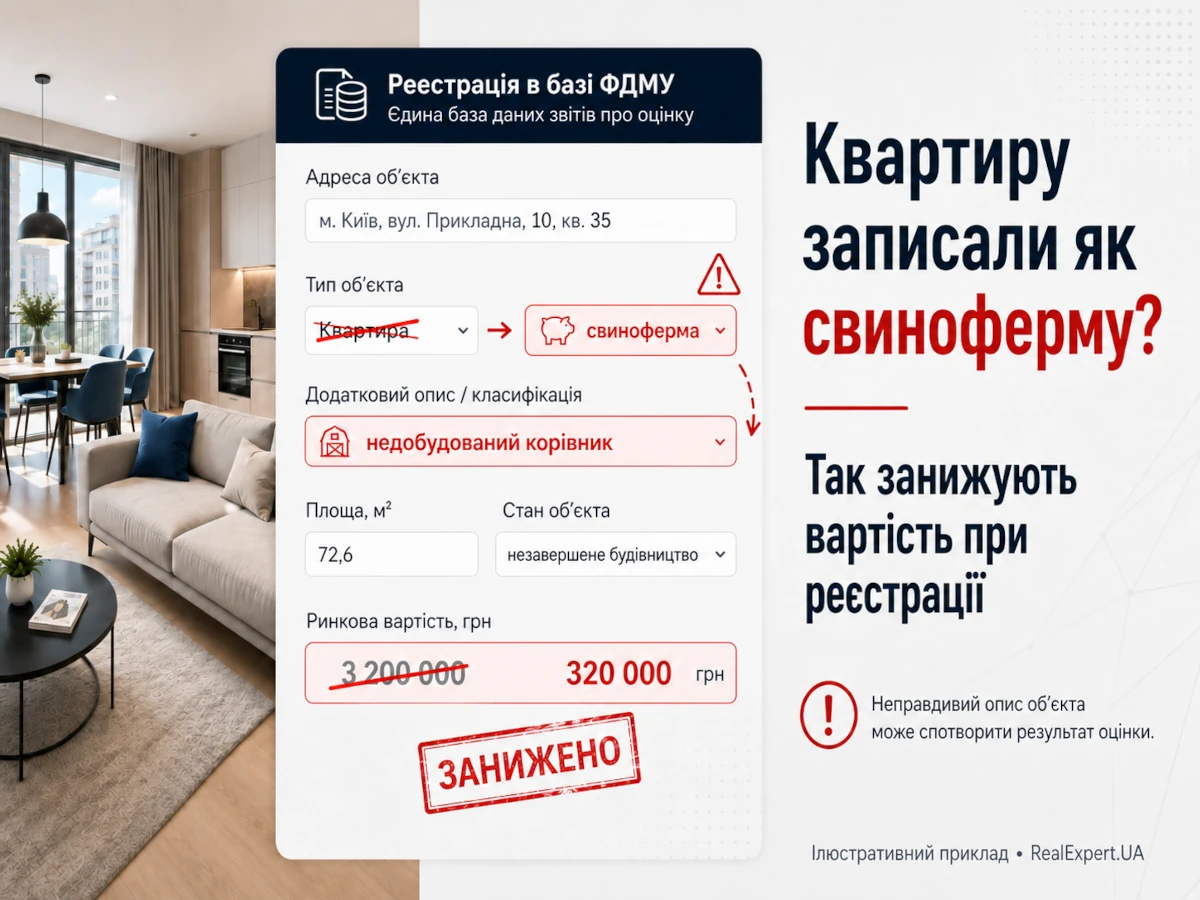
In practice, attempts sometimes occur to manipulate the input data on which the valuation result depends. For example, when obtaining an automatic valuation certificate, an object may be described in a way that makes the database generate a lower value, and then this certificate may be submitted to a notary. Another situation is when the valuation report itself is registered not as a normal apartment, but as an unfinished pig farm, cowshed or another object that clearly does not correspond to the actual characteristics of the property. In a “softer” version, an apartment may be presented as a dormitory room, a share in a communal apartment or another less liquid object, although in reality a regular apartment is being valued.
Such actions should not be treated as an ordinary mistake or a “technical method”. If the description of the object is deliberately distorted in order to obtain a lower value and reduce taxes on the sale, gift or inheritance of real estate, this is essentially document forgery or the use of knowingly false data. The consequence may be not only an incorrect valuation, but also damage to the state in the form of underpaid taxes. That is why the reliability of the object description is directly connected with taxes on the sale, gift and inheritance of real estate in Ukraine.
Electronic documents and electronic signature
Today many documents exist not only on paper. Extracts, certificates, agreements, financial documents, reports and correspondence with institutions may be electronic. Under the Law of Ukraine “On Electronic Documents and Electronic Document Flow”, an electronic document is a document in which information is recorded as electronic data, including mandatory details.
For an appraiser, this means that an electronic extract or electronic document is not “inferior” merely because it has no wet seal. But it must be obtained from a proper source, contain the required details and allow the appraiser to verify the information used in the valuation.
A separate risk is giving electronic signature files to third parties. If a key, password or access to an online account gets into another person’s hands, it may later be difficult to prove who actually signed a document or submitted information. Electronic documents should therefore be protected no less carefully than paper originals.
Signs that documents should be treated with caution

A client does not need to become a forensic document expert. But there are simple warning signs that should be noticed before ordering valuation:
- different documents show different area, address or cadastral number;
- the document contains corrections, erasures, unclear seals or strange page copies;
- the owner in the documents does not match the person ordering the valuation;
- there is a power of attorney, but its content or validity period raises questions;
- the object has actually been reconstructed, while the documents remain outdated;
- for land, there is no clear data on the cadastral number or designated use;
- for a company, there are no current financial statements, but corporate rights need to be valued;
- the client asks the appraiser not to consider obvious characteristics of the property because “it will be more convenient”.
One such sign does not prove forgery. But it does mean that additional questions should be asked before the valuation is prepared.
What to do if documents raise doubts
If documents do not match each other, the worst decision is to ask the appraiser to “do it somehow”. It is usually better to first find out where exactly the problem is: in the technical passport, in the title document, in the register, in the old address, in a notarial mistake or in the object itself. If there is no proper title document or it raises questions, this should be clarified before the valuation report is ordered.
In simple cases, it may be enough to obtain an up-to-date extract, clarify data with a notary, order a new technical passport or provide the appraiser with an additional document. If the matter involves inheritance, a court dispute, corporate rights or a questionable power of attorney, it is better to involve a lawyer or notary before ordering the report.
If a valuation report has already been prepared and there are doubts about its quality, Ukrainian law provides for the possibility of reviewing the report. This is not the same as “making another valuation”, but a professional critical review of the appraiser’s work. Such a review may be important in court, in a dispute between parties or when checking the quality of a report.
Liability for document forgery: in brief

Criminal liability for document forgery is primarily provided for by Article 358 of the Criminal Code of Ukraine. It concerns the forgery of certificates and other official documents, seals, stamps and forms, as well as the use of a knowingly forged document.
For property valuation, it is important that an official document is not only a passport or a certificate issued by a state authority. A document may be issued or certified by different persons and organizations if it has the established form, required details and confirms facts of legal significance. A valuation report is such a document: it confirms a conclusion on the value of property and may be used for a notarial act, court, accounting or another legally significant purpose.
The Criminal Code also provides for liability for abuse of authority by persons providing public services. This provision directly mentions appraisers. Therefore, the risk is not limited to the physical forgery of a seal or signature. It may also arise from abuse of professional authority when preparing a document.
For the client, the main conclusion is simple: it is not worth asking an appraiser for a fictitious amount or providing documents whose reliability is doubtful. If valuation is needed for a notary, court or accounting, it is better to spend a little more time checking the input data than later explain why false information appeared in an official document.
Conclusion
Documents in property valuation are not a formality. They determine which object is being valued, who owns it, what characteristics it has and how the result will be used. An error in a document is not always a disaster, but it must be noticed and properly taken into account.
Forged or questionable documents are a completely different story. They may make not only the valuation report, but also a notarial act, court position or accounting decision unusable. If the report itself is knowingly prepared with false data, a genuine signature and valid appraiser’s documents do not make it safe.
Liability for an unreliable report does not always rest only with the appraiser. If the client knowingly provided incorrect input data, concealed important information about the object or agreed with the appraiser on a predetermined result, the client may also become one of the persons whose actions are examined. This is especially relevant where the report was used to reduce taxes, influence a court dispute, affect accounting or achieve another legally significant purpose.
That is why a good-faith valuation starts with simple things: honest documents, real characteristics of the property, a clear purpose of valuation and refusal to “write the required amount”. This ultimately protects the client, the appraiser and everyone who will rely on the report.
If you need property valuation, valuation for a notary or valuation for court in Ukraine, it is better to tell the appraiser about all document-related details at once. This helps avoid unnecessary questions at the stage of notarial execution, court proceedings or report verification.