
If you need an official report for a notary, court, inheritance, division of property or another legal purpose, the service terms are described on the apartment valuation page. In this article, however, we are talking specifically about the logic of the calculation: how an appraiser arrives at the final figure and why it may differ from the owner’s expectations.
What Is the Market Value of an Apartment?
Market value is not the maximum amount the owner would like to receive when selling, and not the minimum price for which the apartment is ready to be sold “right now”. It is the most probable price at which the property could be sold under normal market conditions: without pressure on the seller or buyer from specific circumstances and with enough time for the sale.
When an owner asks how much their apartment is worth, they have usually already looked through several listings on OLX, DOM.RIA or other platforms. Sometimes the answer seems obvious: take similar apartments, calculate the average price — and that is it. The direction of thought is certainly correct, but real valuation has important nuances.
The price in a listing shows how much the seller wants to receive. This does not mean that the apartment will actually be sold for that amount. Some owners set the price with a large margin for negotiation, others follow their neighbours’ prices, and some simply test demand. The opposite also happens: a property is listed slightly below the market to attract more buyers and create competition between them. Therefore, a listing is not always a “pure” market value, but often part of the chosen sales strategy.
How an Appraiser Selects Similar Apartments for Comparison
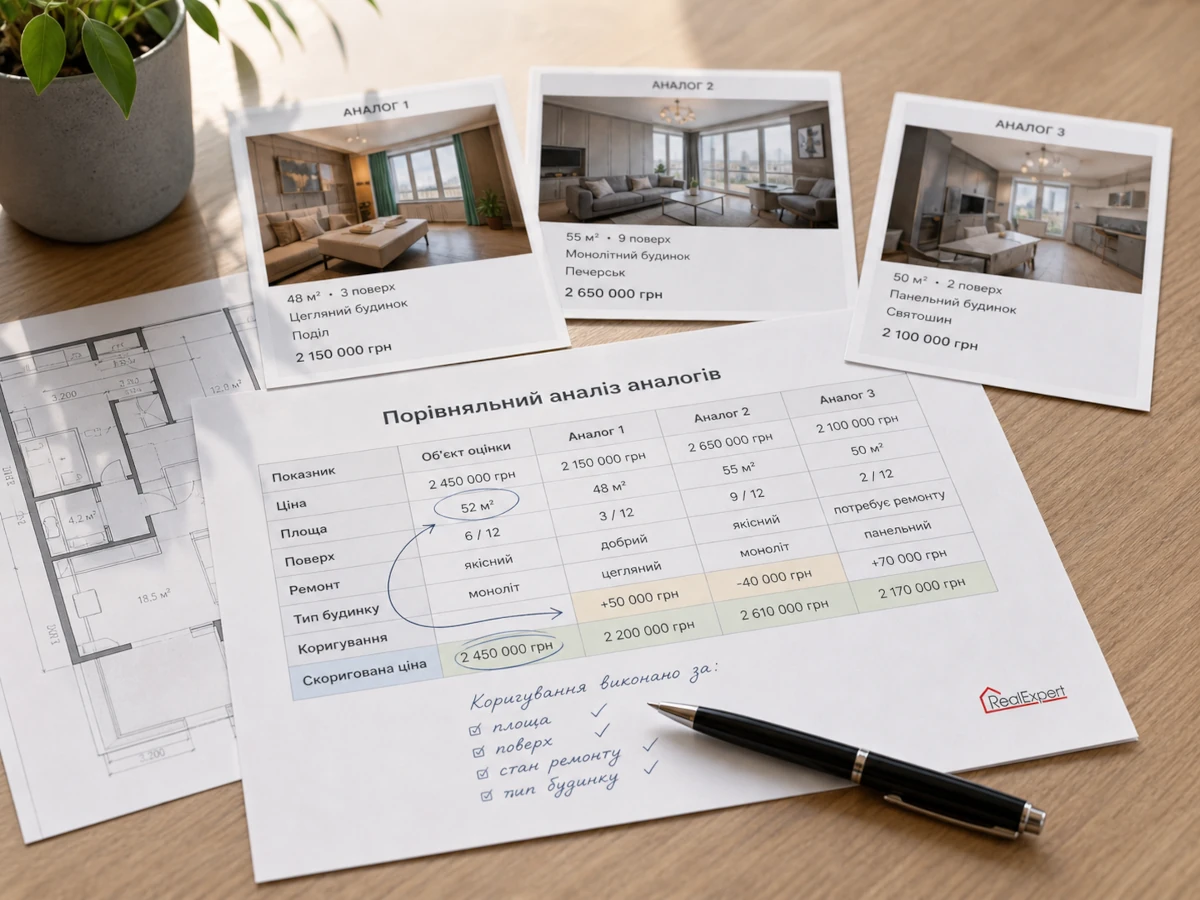
Apartment valuation usually begins with the search for the closest comparable properties: a similar, and ideally the same, microdistrict, building type, area, number of rooms, floor and condition. Then the appraiser looks at how these apartments differ from the one being valued and makes adjustments. If a comparable property is better, its price is conditionally reduced; if it is worse, its price is increased. This brings different offers to a more comparable form and gives a value range specifically for the apartment being valued.
Most often, differences arise in details that may seem secondary at first glance: the floor, difference in total area, availability of an elevator, renovation, layout and distance from the metro.
The appraiser also looks at the quality of the listings themselves. An excessively high price may mean that the seller is simply testing demand or has left a large margin for negotiation. But an excessively low price is not always a direct benchmark either: sometimes it reflects urgency, a legal problem, poor condition, a conflict between owners or another “catch” that needs to be clarified separately. In real estate transactions, an understated price is often used as a way to quickly attract a buyer’s attention, so it is useful to remember typical fraud schemes when buying an apartment. At the same time, the lower boundary of the market cannot be completely ignored. A buyer will not pay more for an apartment if a genuinely similar property nearby can be bought cheaper. Therefore, the appraiser usually focuses on the realistic lower range of comparable offers, excluding clearly problematic and irrelevant options.
Why You Cannot Simply Take the Average Price from Listings
The average price from listings often gives a distorted picture. One set may include apartments with good renovation and without renovation, first and middle floors, houses near the metro and houses far from transport, properties with proper documents and options with legal nuances. Formally, all of them may be “two-room apartments in the district”, but for a buyer these are completely different offers.
In addition, listings almost always leave room for negotiation. The seller may set a price higher than the amount they are actually ready to accept in order to have room for bargaining. Therefore, the appraiser looks not only at the stated price, but also at how realistic it is: how similar the property is to other offers, how long it has been on the market, and whether the price looks out of line with the market.
What Factors Affect the Value of an Apartment?
In valuation, such characteristics are often called value-forming factors. These are all the features that may noticeably change the buyer’s interest and the final price of the property.
For an apartment, usually it is not one or two features that matter, but their combination. A good district may partly compensate for modest renovation, but it will not always outweigh an inconvenient layout. New renovation may increase interest in the property, but it will not make an old building comparable to a modern residential complex. That is why the appraiser looks at the apartment as a whole.
District and Location of the Building
The district has a very strong effect on value, but even within one district prices may differ. A building near the metro, a park, a school, on a quiet street and with a normal courtyard is perceived differently from a building in the same part of the city but next to a noisy highway or industrial zone.
A buyer evaluates not only square metres, but everyday life: how to get to work, where to park the car, whether it is convenient for children to go to school, whether there are shops nearby, and whether it feels safe and comfortable to return home in the evening. Therefore, two apartments of the same area may have different values even because of the local location of the building.
Building Type and Year of Construction
The type of building is one of the factors that owners sometimes underestimate. On paper, two apartments may look very similar: both in old housing stock, both not far from the centre, both with one or two rooms. But the market often sees a “Khrushchevka” and a “Stalinka” as different categories of housing.
A modern residential complex and an old panel building cannot be valued in the same way just because they are located in the same district and have a similar area. Even among Soviet-era buildings, the difference may be noticeable: in some cases the kitchen is extremely small, in others the rooms are walk-through, and in others the bathroom is inconveniently located or too small. The same applies to differences in the quality and condition of internal building utilities.
A small apartment in a Khrushchevka and a more spacious apartment in a Stalin-era building may differ very significantly in price per square metre in favour of the Stalinka. Stalinkas usually have higher ceilings, thicker walls and better layouts. Khrushchevkas, on the contrary, more often have small kitchens, cramped bathrooms, low ceilings and adjoining walk-through rooms.
This helps explain why the market perceives such buildings differently, even when the location and the formal number of rooms seem similar.
Area and Layout
In apartment valuation, not only the total area matters, but also the so-called scale factor. Usually, the smaller the property, the more expensive one square metre is. This is clearly seen in the case of small studio-type apartments, dormitory rooms and rooms in communal apartments. The total price of such housing is lower than that of a full apartment, but the price per square metre often turns out to be higher. The principle is roughly the same as in wholesale purchasing: the larger the total volume, the lower the unit price.
But there is no universal rule here either. In ordinary middle-class apartments, the influence of area on the price per square metre may be small or almost unnoticeable. In the segment of large expensive apartments, things sometimes work the other way around. If we are talking about an apartment of 200 sq.m or more in a good building and a rare location, the square metre may cost not less, but more compared with apartments of “average” size. Demand for such properties is not mass-market by itself, but in a good location the supply may be even smaller.
The layout affects value just as much. Adjoining rooms in Khrushchevkas are a familiar problem: such an apartment is less convenient for a family, it is more difficult to divide into functional zones, and part of the area is used less efficiently. But in practice, a small kitchen, a cramped bathroom and a narrow corridor are often felt even more strongly. In old buildings, these zones often make an apartment inconvenient for everyday life, even if the total area looks acceptable on paper.
That is why the appraiser looks not only at the number of square metres, but at how they are distributed. Usable area, a proper kitchen, a convenient bathroom, isolated rooms and reasonable room proportions may be more important than a formal difference of a few metres.
Floor and Availability of an Elevator
The floor may be both an advantage and a disadvantage. Middle floors are usually perceived more calmly by the market: not the first, not the last, fewer risks related to the roof or dampness, and more convenient for most buyers.
An apartment on the ground floor is not always automatically worse: for some people it is a disadvantage because of noise, dampness or windows at courtyard level, while for others it is an advantage — no elevator is needed, it is convenient for elderly people, and a separate entrance for commercial use may be considered. The same applies to apartments on the upper floors: in an old building this may mean risks related to the roof and weak water pressure, while in another case it may mean a good view, more light and no neighbours above. In valuation itself, this factor is not considered separately from everything else, but together with the type of building, the condition of the entrance hall, the elevator and the overall liquidity of the property.
Condition of Renovation
Renovation affects value, but not always in the way the owner expects. Fresh neutral renovation may increase buyers’ interest because the apartment is ready for living or for rent. But expensive renovation does not necessarily return its cost in full: people have different tastes, and some buyers will still remodel the apartment “for themselves”. A buyer may consider the furniture unnecessary, the appliances outdated, the wall colour unsuccessful and the built-in wardrobes unsuitable.
The impact of renovation depends strongly on the class of the apartment. In the budget segment, the so-called “livable condition” often differs little from “needs renovation”, and sometimes is even perceived worse. The buyer is still planning to redo everything, but additionally receives the cost of dismantling, removing old furniture, replacing outdated materials and bringing the apartment up to modern requirements. Today, free space, a minimum of unnecessary furniture and practical modern solutions are often valued more than the simple possibility to “move in and live” with an old renovation.
In the expensive segment, the logic is different. Either fresh, high-quality and neutral renovation made before the sale works well, or an apartment prepared for finishing, where the new owner can implement their own project. An old expensive renovation, even if a lot of money was once invested in it, is not always perceived as an advantage, because the buyer of an expensive apartment usually does not want to use someone else’s furniture, old plumbing and renovation made according to the previous owner’s taste.
This is especially important when the apartment is in poor condition: in such cases, the market may perceive not only the absence of renovation, but also future dismantling and repair costs.
A separate topic is furniture and appliances. In some cases, they have almost no effect on the value of the real estate; in others, they may be an additional argument when selling. There is a separate article about this: whether the value of furniture and household appliances is taken into account when valuing an apartment.
Documents and Legal Nuances
Hidden problems with documents are not valuation, but a separate legal check. An appraiser does not replace a notary, lawyer or real estate attorney: they do not establish whether there were disputed transactions in the past, whether there are hidden heirs, whether powers of attorney were properly issued, or whether it is safe to buy such an apartment. These issues are usually checked separately before the transaction.
But there are legal circumstances that are visible from the documents and really affect the market perception of the property. One of the clearest examples is the presence of co-owners. An apartment owned by one person and a share in an apartment are different properties in terms of liquidity. A buyer of a share often receives not a specific room, but the right to part of common property without being tied to specific premises. Therefore, when recalculated per square metre, such real estate is usually sold cheaper.
Another example is redevelopment. Sometimes it makes an apartment more convenient and increases its attractiveness, while in other cases it creates risks for the buyer.
Why the Valuation Date Matters
Real estate prices change over time, both upward and downward, so the report always states the valuation date. This is the date as of which the value of the property is determined. For an ordinary sale, the current value is most often determined. But for court proceedings or tax returns, including those filed abroad, it is often necessary to determine the value as of a date in the past. For example, as of the date the apartment was purchased, the date the spouses stopped living together, or the date of immigration.
This format of work is called retrospective valuation. You can read more about it on the retrospective real estate valuation page.
If the document is needed for a foreign tax authority, migration service, social benefits or another foreign procedure, it may require not only a retrospective valuation date, but also a short English-language version of the key pages of the report.
Apartment Valuation Report
An official valuation report is prepared according to established rules and contains a description of the property, market analysis, calculations, a conclusion on value and the appraiser’s details. Such a document may be needed for a notary, court, inheritance, division of property, sale of a share, tax purposes and other situations.
That is why the appraiser does not simply name a figure, but substantiates it. The valuation report should show which comparable properties were used, which differences were taken into account and how the final result was formed. You can read separately about what the client receives in the article about the result of the appraiser’s work.
If you need an official document, you can read more about the service on the apartment valuation page.